
Blog Post
Looking for an Aumni Alternative?
NEW 🚀
Blog Post

Built on Foresight | Powered by your live data

Fund Scenario Modeling, built on data you already trust.

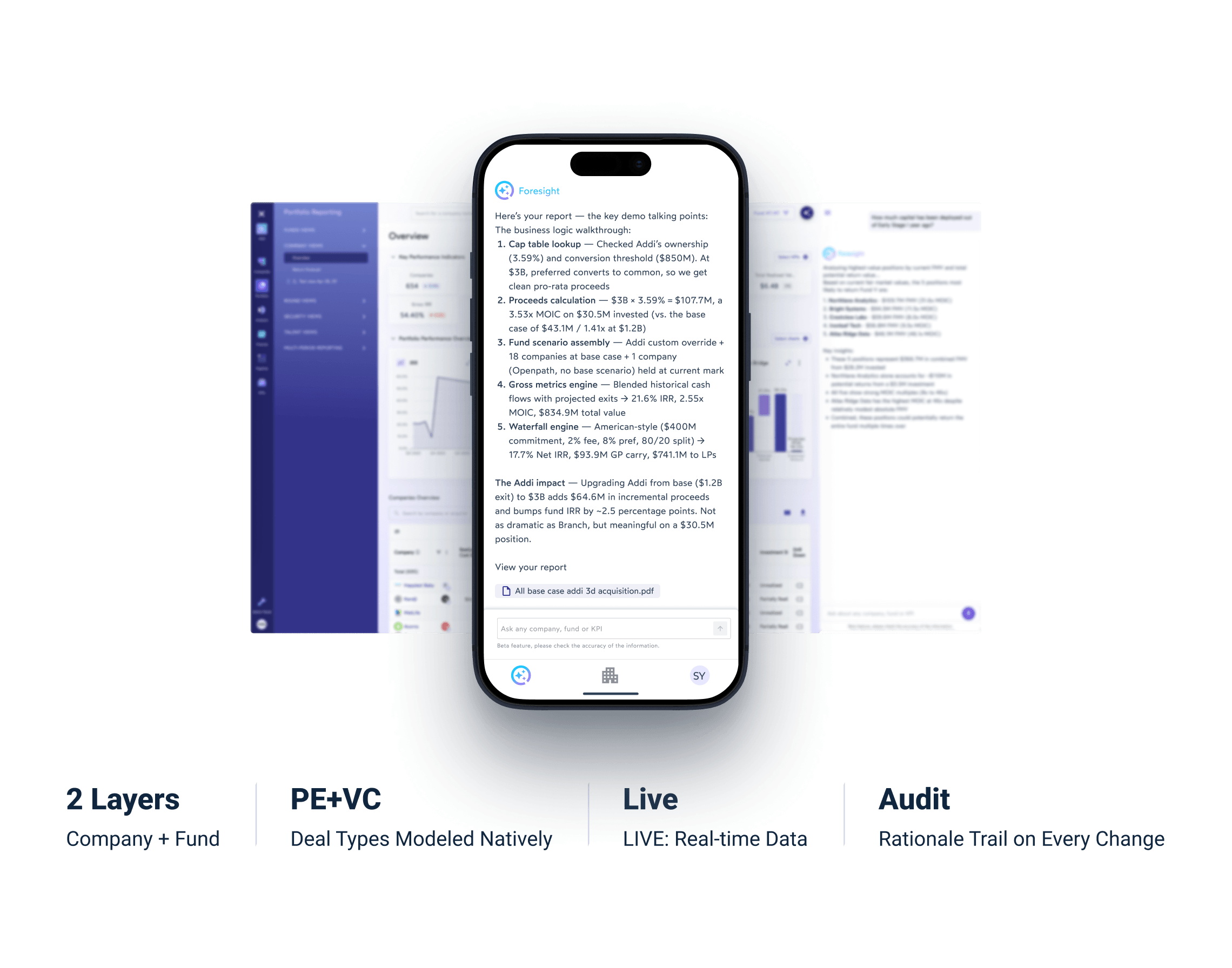
Build company-level exit scenarios, compose them into fund-level forecasts — IRR, MOIC, DPI, TVPI, and waterfall — all on the same live data already running your reporting.
May 12, 2026
5 min read
Share:

Stop modeling on stale exports. Model on live data.

Most funds model forward returns in spreadsheets.

Today’s Reality

Someone exports cap tables and holdings, types them into Excel, builds a column for each scenario, and the file goes stale the moment a new mark lands.

Decision-Making Friction

By the time a partner asks “what if Acme exits at 8x?” in an IC meeting, the answer is either “let me get back to you” or a number nobody fully trusts.

Foresight's Scenario Modeling sits on top of the same live holdings, cap tables, fund accounting, and waterfall data already powering your reporting.

Live Portfolio Data

Your deal team

builds company-level scenarios — VC events, PE add-ons, dividend recaps, exits.

Waterfall Intelligence

Your finance team

composes those into fund-level models with full waterfall economics.

Interactive Scenarios

Partners

explore “what if” questions in real time.

Rationale Tracking

Every assumption

carries a rationale trail. When source data changes, scenarios recalculate automatically.

Company- and Fund-level scenarios, unified.

Company-level assumptions automatically roll up into fund-level outcomes — keeping ownership, dilution, returns, and exposure connected across the entire model.

Company Scenarios

For each portfolio company, build a forward model from current state to exit. Add the events you expect — financing rounds, bridges, secondaries, add-on acquisitions, dividend recaps, debt refinancings — then set exit assumptions. Current state is read-only and pulled live from Foresight, so you start from the truth.

VC events: Series rounds, bridges, secondaries, down rounds
PE events: add-ons, recaps, refinancings, milestones
Best · base · worst · custom variants per company
Exit method, timing, valuation
Returns attribution: growth · multiple · leverage
Owned by Deal Teams
The people who actually attend the board meetings build the model. They see only their companies, not the full fund. Quarterly cadence; faster when material events happen.

Fund Scenarios

Compose the company scenarios into a fund-level model. Pick best/base/worst per company, add hypothetical new investments, apply your waterfall and fee structure, and produce LP-ready outputs. Multi-fund views show how a single exit affects every fund holding the company.

IRR · MOIC · DPI · RVPI · TVPI
Cashflow projections (J-curve, calls, distributions)
GP carry & LP returns through full waterfall
PE-specific: returns attribution, leverage profile
Sensitivity analysis on key drivers
Owned by Finance & CFO
Includes a “Ready for Review” dashboard for company scenarios coming in from deal teams. Modify-with-attribution if you change an assumption — deal teams get notified, history stays clean.
Deal Team Sessions
Build a forward model for one company.
Typically 15–45 minutes per company, done quarterly or when something material happens
Open the company
Current state pulled live from Foresight (read-only)
Add an event
Series C · bridge · secondary · add-on · recap
AI suggests
“Comparable Series Cs raised at this stage at...”
You decide
Accept · modify · reject — logged either way
Add another
Events run sequentially, downstream auto-recalculates
Set exit
Method · timing · valuation · returns attribution
Document why
Lightweight rationale — short text and tags
Hand off
Mark “Ready for Review” — finance gets notified
Why this matters
Your deal team are the experts on their companies — they sit on boards, take CEO calls, see the operating data. The system gets out of their way and just captures what they already know, in a structure finance can compose into a fund model.
The Finance Session
Take incoming company scenarios from deal teams and compose them into a fund-level model.
Quarterly cadence, more structured than deal-team sessions.
Review dashboard
All "Ready for Review" scenarios across funds
Read rationale
Why every assumption was set — full audit trail
Accept · modify · return
Modifications attributed to you, deal team notified
Pick scenarios
Best · base · worst · custom per company
Add hypotheticals
New investments — checked against dry powder
Apply economics
Waterfall · fees · carry · preferred return
Review outputs
IRR · MOIC · DPI · TVPI · cashflow · sensitivity
Lock for LP
Frozen as the source of record for reporting
Why this matters
Finance owns the final number. They need to see how the deal team got there, modify with attribution when something doesn't reconcile, and produce LP-ready outputs that match the way your waterfall actually pays. All of that happens here, not in a side spreadsheet.
The Partner / IC Session
Live exploration during IC meetings, partnership reviews, or LP conversations.
Speed and conversational interaction are what matter.
Open the scenario
Pre-built by deal team and finance
Ask a what-if
"What if Acme exits at 8x?" — natural language to the agent
See it instantly
Recalc happens at conversation speed
Compare side-by-side
8x vs 12x vs strategic acquirer
Cross-fund view
How does Acme's exit hit Funds I, II, III?
Save a version
Named save so the exploration isn't lost
Pull up rationale
Tap any number to see why it's there
Export for the room
PDF for IC deck, Excel for the model nerd
Why this matters
When a partner asks a question in IC, the answer should land before the next agenda item, not in tomorrow's followup email. The system collapses the time between question and defensible answer — that's the difference between scenario modeling that gets used and scenario modeling that gets exported once and forgotten.

From "let me get back to you" to "here's the answer."

Real-time IC

What-if at conversation speed

Partners ask “what if Acme exits at 8x?” and see the IRR, MOIC, and DPI impact instantly — not after lunch. Live recalculation against the same fund accounting data running your reporting.

LP Reporting

Forecasts you can defend

Every assumption carries a rationale trail — who set it, when, what the AI suggested, what the deal team decided, what finance accepted. When an LP asks “why this number?”, you have an answer.

PE Workflows

Add-ons, recaps, refinancings — modeled

Returns attribution between EBITDA growth, multiple expansion, and leverage. Covenant compliance through holding period. Consolidated financials on platform-plus-add-ons.

Multi-fund

One exit, every fund affected

When the same company sits across Funds I, II, and III, exits and recaps fan out automatically. No reconciling three spreadsheets that disagree about Acme's mark.

Operating Cadence

A real handoff, not an email chain

Deal team marks a scenario “Ready for Review.” Finance sees it on a dashboard with the rationale trail. Modify-with-attribution preserves who said what. The quarterly process gets shorter every cycle.

Cashflow Forecasting

Projected net cashflows, by quarter

Capital calls, distributions, and net cashflow projected forward — by fund, by quarter — built from the same company scenarios that produce IRR. The J-curve, planned capital calls, and expected distributions all roll up automatically.

Trusted by some of the smartest firms in the private market

Forecasts you can put a name on.

Built for defensible projections.

Rationale trail

Every assumption logs who set it, when, what the AI suggested, and what the user decided. Append-only. Queryable for audit.

Change attribution

When finance modifies a deal team assumption, the system tracks both versions and flags who changed what. No anonymous edits.

Lock for LP reporting

Finalized scenarios can be locked — frozen as the source of record for an LP report or IC deck. Edits after lock require re-versioning.

AI suggests, never decides

The AI agent surfaces data-grounded suggestions. Users accept, reject, or modify. The system never applies changes without explicit confirmation.

Firm-isolated

Scenarios are scoped to your fund's workspace. Never shared across firms. Never used for model training.

SOC 2 & encryption

Foresight operates under SOC 2 controls. TLS in transit, at-rest encryption on every record.

What partners ask first.

Fund scenario modeling: frequently asked questions.
What is fund scenario modeling?
What’s the difference between cap table modeling and fund scenario modeling?
How is fund scenario modeling different from Excel?
How does AI work in Foresight’s scenario modeling?
How do fund scenarios update when underlying data changes?
Does Foresight support PE scenario modeling — add-ons, recaps, dividend recaps?
Can you model the same portfolio company across multiple funds?
How does scenario modeling integrate with fund accounting and European waterfall calculations?

See fund scenario modeling in action.

Book a 30 min demo to learn how Foresight can turn your 'what-ifs' into strategic capital allocation decisions.

Thank you.

We've received your message and will reach out to you soon.
Oops! Something went wrong while submitting the form.